1.2 Units that matter: kW, kcal/h, TR, BTU/h and converting between them
Capacity means how much heat a machine moves per unit time. The SI unit is the kilowatt (kW). One kW means one kilojoule every second.
In India you will still meet older units on nameplates and quotations. Cooling is often quoted in tons of refrigeration (TR). Boilers are often quoted in kcal/h. Imported equipment may use BTU/h (British thermal units per hour).
One TR is the heat needed to melt one short ton of ice in 24 hours. It is a cooling rate, not a weight. A "1.5 ton AC" removes about 5.3 kW of heat.
Energy (kWh) and power (kW) are different. Power is the rate. Energy is power multiplied by time. A 2 kW heater running 3 hours uses 6 kWh.
| From | To kW multiply by | Notes |
|---|---|---|
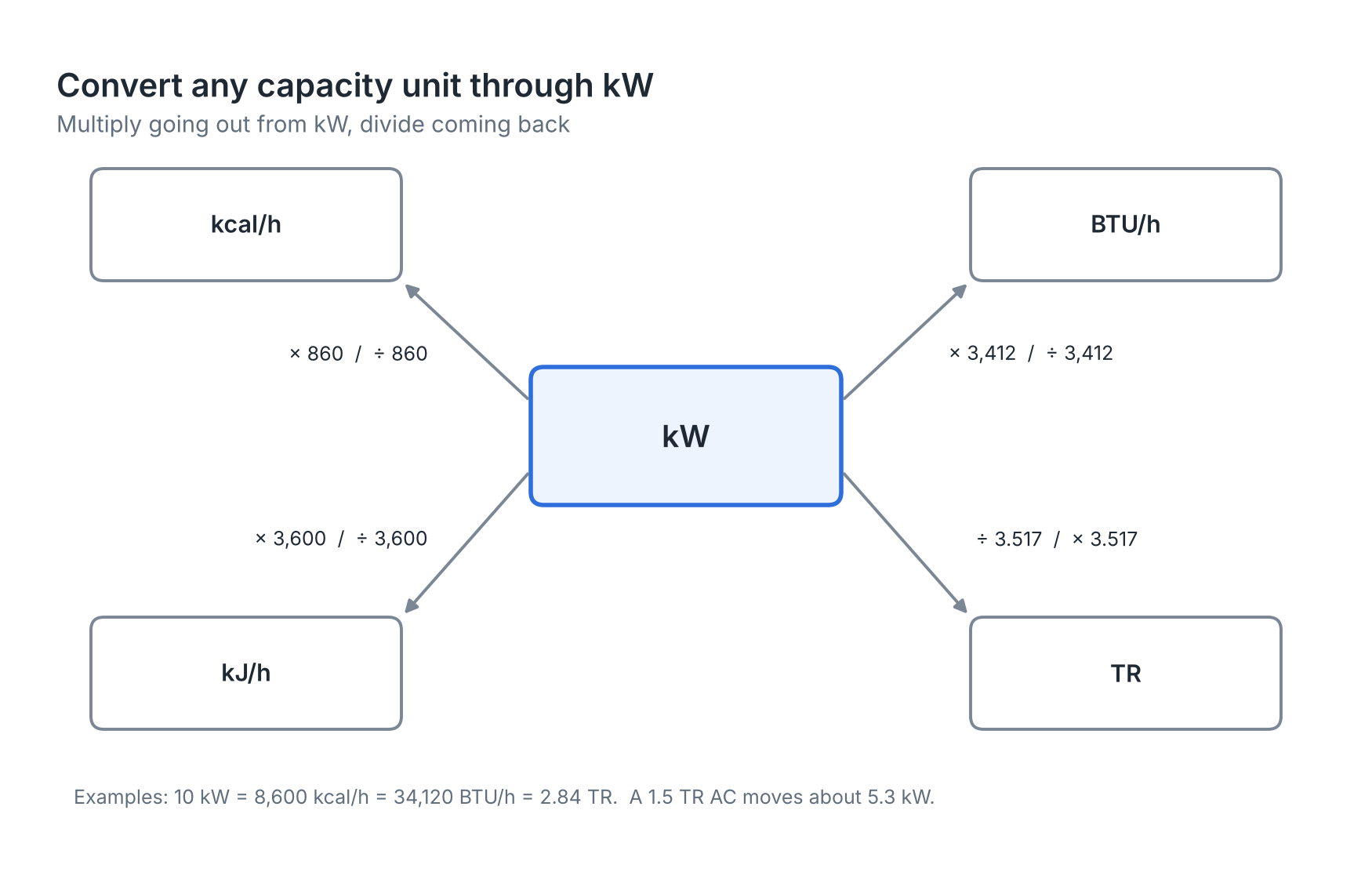
| 1 kcal/h | 0.001163 | 1 kW = 860 kcal/h |
| 1 TR | 3.517 | 1 TR = 12,000 BTU/h = 3,024 kcal/h |
| 1 BTU/h | 0.000293 | 1 kW = 3,412 BTU/h |
| 1 HP (motor power) | 0.746 | Mechanical/electrical power, not heat capacity |
Worked example — compare a boiler and a heat pump quote
A hotel in Pune has an old boiler rated 1,00,000 kcal/h. A new quote gives a heat pump in kW. What kW matches?
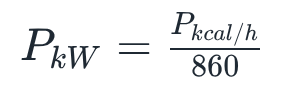
- P = 1,00,000 ÷ 860 = 116.3 kW.
- In TR terms: 116.3 ÷ 3.517 = 33.1 TR.
- In BTU/h: 116.3 × 3,412 = 3,96,800 BTU/h (about 4 lakh BTU/h).
Remember
- Convert everything to kW first, then compare.
- 1 TR = 3.517 kW; 1 kW = 860 kcal/h; 1 kW = 3,412 BTU/h.
- kW is a rate (power); kWh is an amount (energy).
- HP on a compressor is motor power, not heating capacity.
All heating and cooling capacities are rates of energy flow, and they convert to kW with a few fixed numbers.
There are no comments for now.
to be the first to leave a comment.