1.5 The laws of thermodynamics in plain words
Thermodynamics is the science of heat, work and energy. Four laws are usually listed, numbered zero to three. For heat pump work, the first two matter most.
Zeroth law. If two bodies are each at the same temperature as a third, they are at the same temperature as each other. This is why thermometers work.
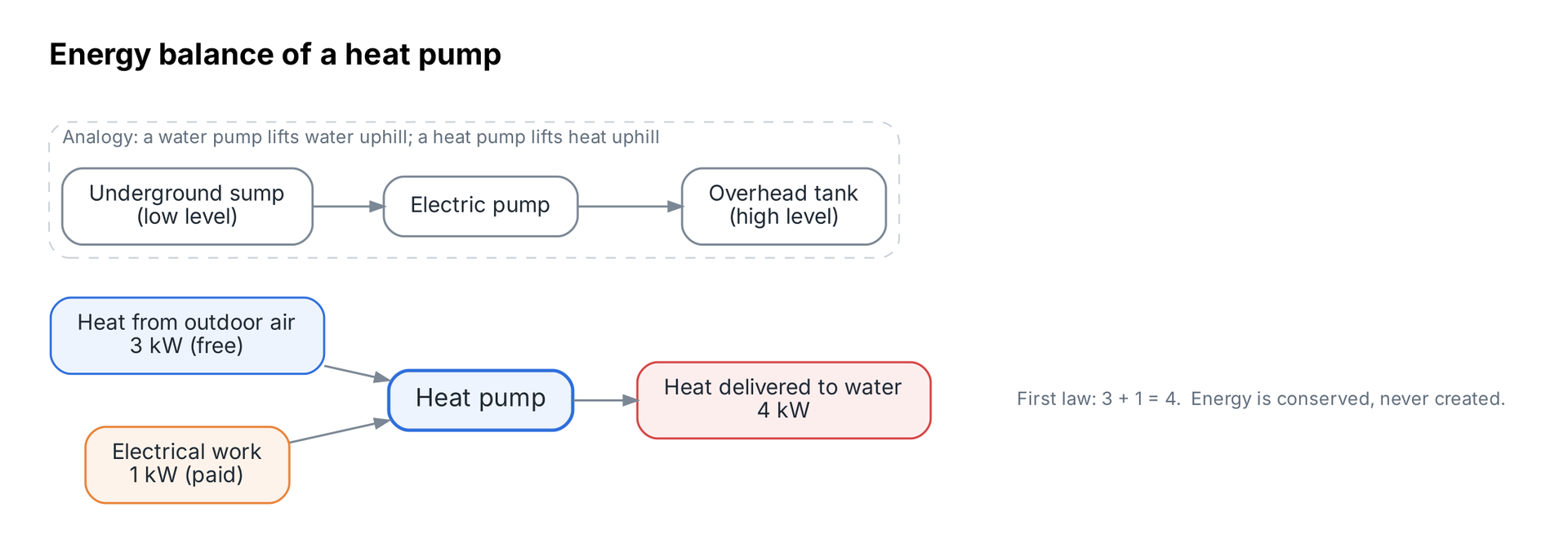
First law (conservation of energy). Energy can change form but cannot be created or destroyed. In a heat pump: heat delivered = heat taken from the source + electrical work put in.
Second law. Heat flows naturally from hot to cold. To move heat from cold to hot, you must supply work. A fridge needs electricity to push heat out of the cold cabinet into the warmer kitchen.
The second law also sets a ceiling. No real machine can beat the ideal Carnot cycle, a theoretical perfect cycle. Real machines reach only part of that limit.
Third law. As a substance approaches absolute zero (0 K), its disorder approaches a minimum. It rarely matters in field work.
Think of a water pump lifting water from a sump to an overhead tank. Water flows down by itself. Lifting it up needs a pump and electricity. A heat pump "lifts" heat in the same way.
| Law | Plain words | What it means for a heat pump |
|---|---|---|
| Zeroth | Equal temperatures are in balance | Sensors and thermometers can be trusted |
| First | Energy is conserved | Heat out = heat in + work in |
| Second | Heat flows hot to cold unless work is added | Compressor work is needed; there is a maximum COP |
| Third | Absolute zero is a limit | Temperatures in K are always positive |
Worked example — ideal (Carnot) heating COP for a Chennai hot water job
Source: outdoor air at 30 °C. Sink: water at 60 °C. Convert to kelvin first.

- Thot = 60 + 273 = 333 K; Tcold = 30 + 273 = 303 K.
- COPCarnot = 333 ÷ (333 − 303) = 333 ÷ 30 = 11.1.
- Real air-source heat pumps at these conditions typically reach COP 3.5–4.5, about 30–40% of Carnot.
Remember
- First law: heat delivered = source heat + electrical input.
- Second law: moving heat uphill always costs work.
- Smaller temperature lift means higher possible COP.
- Always use kelvin in Carnot formulas.
Energy is never created or destroyed, and heat only flows from cold to hot if we spend work to push it.
There are no comments for now.
to be the first to leave a comment.