1.4 Conduction, convection and radiation
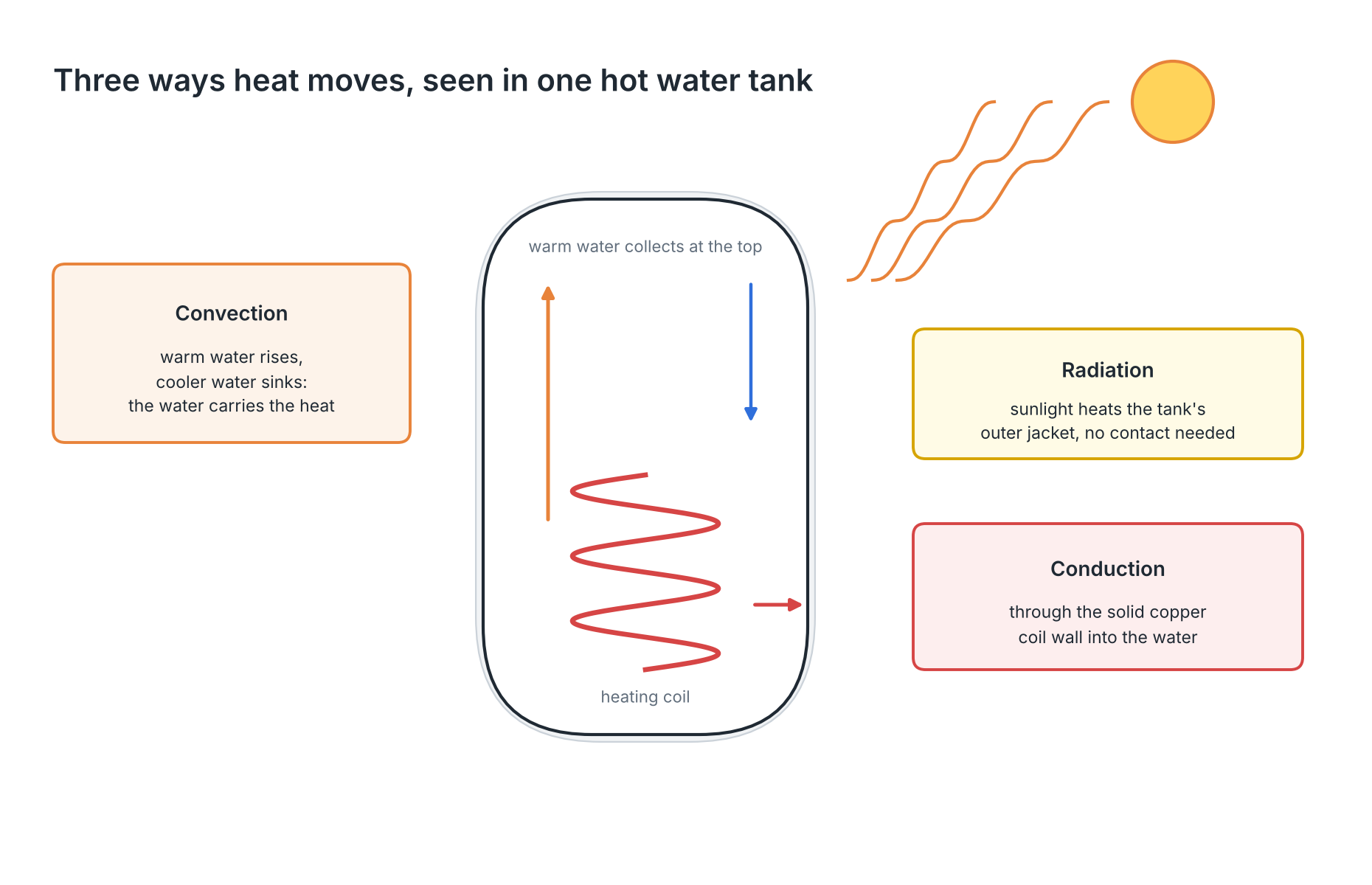
Conduction is heat passing through a material, molecule to molecule. A steel spoon in hot chai gets hot at the handle. Copper and aluminium conduct well, which is why heat exchangers use them.
Convection is heat carried by a moving fluid, such as air or water. Natural convection happens on its own: hot water rises in a geyser tank. Forced convection uses a fan or pump, like the fan on an outdoor unit.
Radiation is heat travelling as infrared waves. It needs no medium. You feel it from the sun on a terrace, or from a hot tandoor wall.
Insulation works by slowing conduction. Materials like PUF (polyurethane foam) and nitrile rubber trap tiny pockets of still gas. Still air and gas conduct heat poorly.
| Material | Thermal conductivity, W/m·K (typical) | Use |
|---|---|---|
| Copper | about 390 | Tubes, heat exchangers |
| Aluminium | about 200 | Fins |
| Carbon steel | about 50 | Tanks, pipes |
| Stainless steel | about 15 | Tanks, plate heat exchangers |
| Water | about 0.6 | Heat transfer fluid |
| Still air | about 0.026 | Trapped in insulation |
| PUF insulation | about 0.022–0.030 | Tank and pipe insulation |
Worked example — heat loss through a pipe wall vs insulation (conduction)
Compare 1 m² of 2 mm steel with 1 m² of 25 mm PUF, each with a 40 K temperature difference.
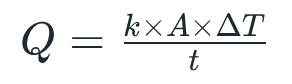
- Steel: Q = (50 × 1 × 40) ÷ 0.002 = 10,00,000 W. In practice, the air film outside limits this, but steel offers almost no resistance.
- PUF: Q = (0.025 × 1 × 40) ÷ 0.025 = 40 W.
- The insulation cuts conduction by a factor of tens of thousands. This is why uninsulated hot pipes waste so much energy.
Remember
- Conduction: through solids. Convection: by moving fluid. Radiation: by infrared waves.
- Good conductors (copper, aluminium) go where we want heat to pass.
- Insulation works by trapping still gas.
- Fans and pumps turn natural convection into faster forced convection.
Heat travels in three ways: through solids by conduction, with moving fluids by convection, and as infrared waves by radiation.
There are no comments for now.
to be the first to leave a comment.