10.7 The Kigali Amendment, HFC phase-down and the India Cooling Action Plan
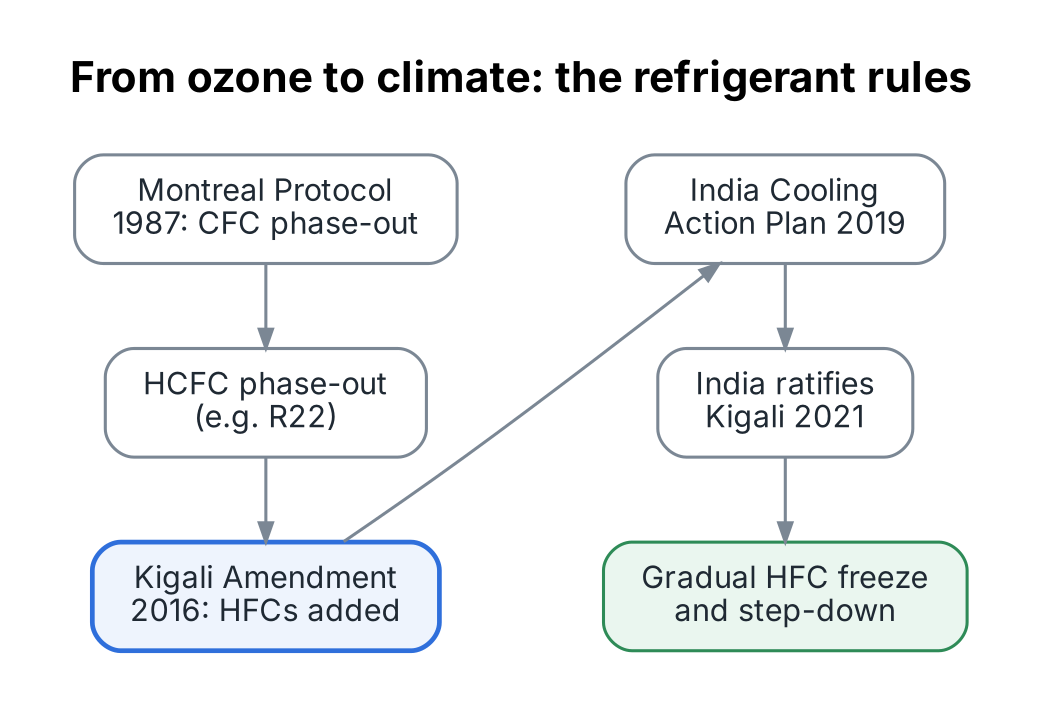
The Montreal Protocol (1987) is the treaty that phased out ozone-depleting gases like CFCs and HCFCs (e.g. R22). It is often called the most successful environmental treaty.
The Kigali Amendment (agreed in 2016 in Kigali, Rwanda) added HFCs to the Montreal Protocol. HFCs do not harm ozone but are strong greenhouse gases. Countries agreed to freeze, then gradually reduce, HFC production and use.
Countries are grouped with different timelines. Developed countries started first. India is in a group of developing countries with a later freeze and slower reduction. India ratified the amendment in 2021.
The India Cooling Action Plan (ICAP), released by the Ministry of Environment, Forest and Climate Change in 2019, looks 20 years ahead. It aims to reduce cooling demand and refrigerant demand, improve efficiency, and train and certify service technicians.
| Gas family | Example | Ozone harm | Climate impact | Status direction |
|---|---|---|---|---|
| CFC | R12 | High | Very high | Phased out |
| HCFC | R22 | Moderate | High | Being phased out |
| HFC | R134a, R410A | None | High | Phase-down under Kigali |
| HFO | R1234yf | None | Very low | Growing |
| Natural | R290, R744, R717 | None | Very low | Growing |
Remember
- Montreal handled ozone; Kigali extended it to HFCs for climate.
- India follows a later, gradual HFC timeline.
- ICAP stresses efficiency, lower demand and technician training.
- Skills for A2L, A3 and CO₂ will be in steady demand.
World rules now cut HFC use step by step, so low-GWP and natural refrigerants are the long-term direction.
There are no comments for now.
to be the first to leave a comment.