10.4 Working with flammable refrigerants (R290 and others)
R290 is propane, the same gas family as LPG. It has excellent efficiency and very low GWP. But a leak can form a burnable mixture with air.
The lower flammability limit (LFL) is the lowest gas-in-air concentration that can burn. For R290 it is about 2.1 % by volume (typical value). Below LFL the mix is too lean to burn.
Propane is heavier than air. Like LPG from a leaking cylinder, it collects at floor level and in pits.
Charge size limits exist in product and installation standards. Indoor parts usually carry small charges; larger charges sit outdoors in monobloc units. Follow the manufacturer's limits.
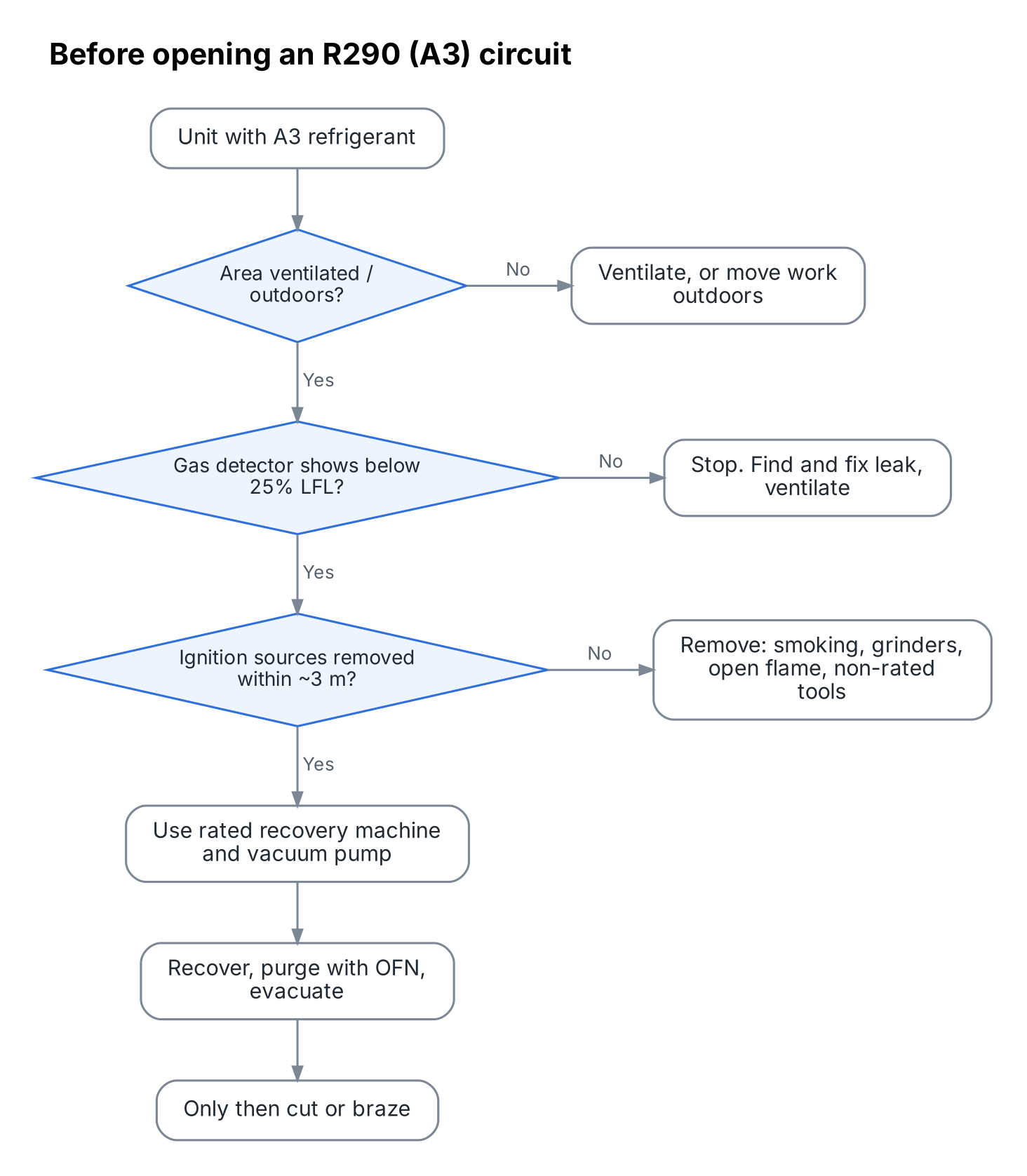
| Rule | R290 (A3) | R32 (A2L) |
|---|---|---|
| Gas detector | Always, set for hydrocarbons | Always, suitable sensor |
| Tools | Spark-free recovery unit and vacuum pump | Rated for A2L |
| Ventilation | Essential; gas sinks to floor | Essential |
| Brazing | Only after recovery and nitrogen purge | Same |
| Cylinder | Marked for flammable gas, red band or label | Flammable label |
Remember
- Use a calibrated gas detector before and during work.
- No smoking, no open flame, no sparking tools in the work zone.
- Recover and purge with nitrogen before any hot work.
- Store and transport cylinders upright, ventilated, away from heat.
- Respect the manufacturer's charge limits.
With A3 and A2L refrigerants, keep gas below its lower flammable limit and keep every ignition source away.
There are no comments for now.
to be the first to leave a comment.