10.3 Refrigerant safety classes: A1, A2L, A3
ISO 817 and ASHRAE Standard 34 classify refrigerants with a two-part code. The letter shows toxicity: A is lower toxicity, B is higher toxicity. The number shows flammability: 1 no flame propagation, 2L lower flammability with slow burning speed, 2 flammable, 3 higher flammability.
So R32 is "A2L": low toxicity, mildly flammable. R717 (ammonia) is "B2L": higher toxicity, mildly flammable.
GWP (global warming potential) compares how much heat a gas traps over 100 years with CO₂, which is 1. AR4 and AR5 are two IPCC assessment reports; they give slightly different values.
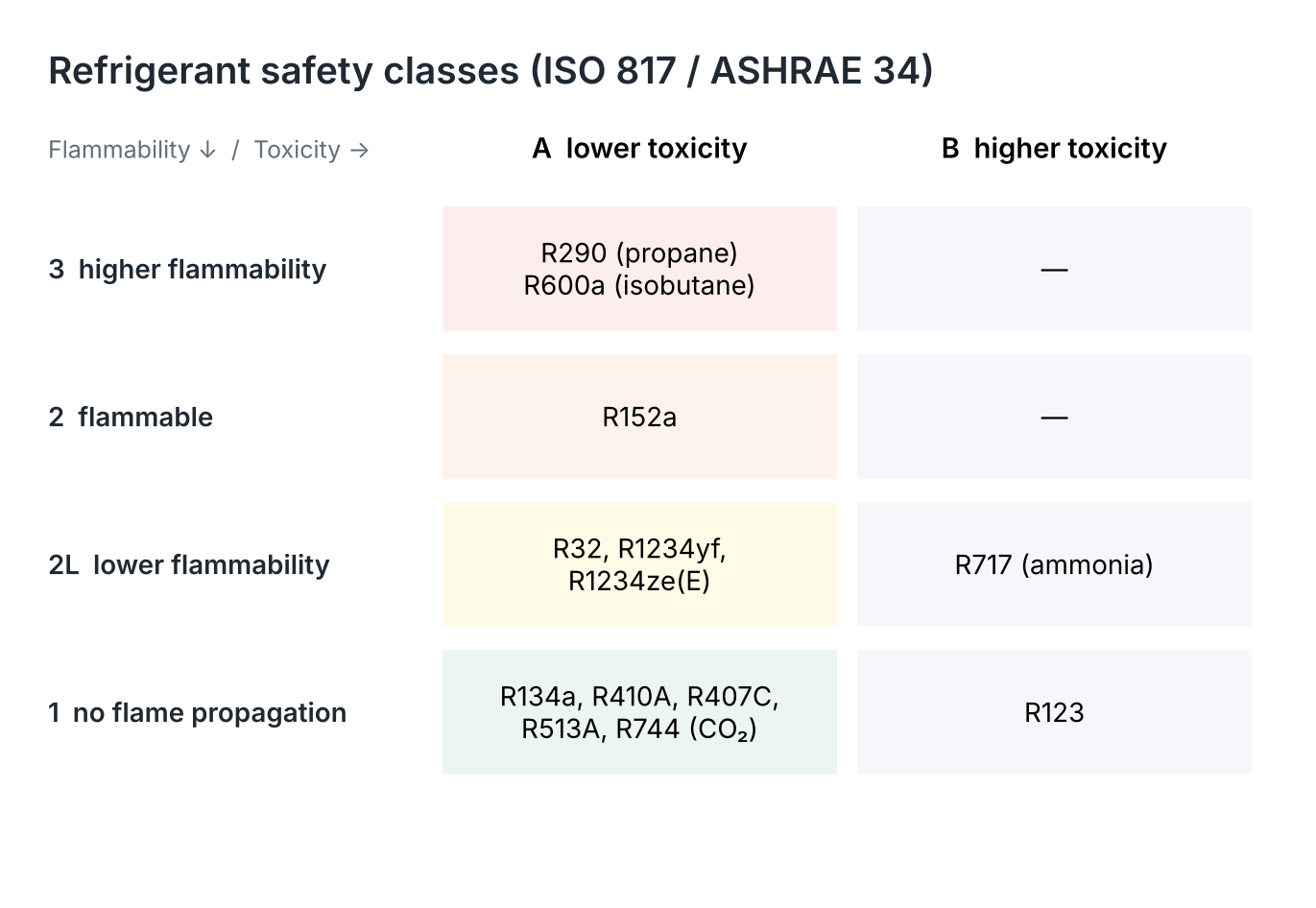
| Flammability \ Toxicity | A — lower toxicity | B — higher toxicity |
|---|---|---|
| 3 — higher flammability | R290 (propane), R600a | — |
| 2 — flammable | R152a | — |
| 2L — lower flammability | R32, R1234yf, R1234ze(E) | R717 (ammonia) |
| 1 — no flame propagation | R134a, R410A, R407C, R513A, R744 (CO₂) | R123 |
Read the class as two parts: the letter is toxicity, the number is flammability.
Refrigerant comparison (GWP values approximate, 100-year)
| Refrigerant | Type | GWP AR4 (approx.) | GWP AR5 (approx.) | Safety class | Typical use |
|---|---|---|---|---|---|
| R134a | HFC | 1430 | 1300 | A1 | Chillers, high-temperature heat pumps, car AC (older) |
| R410A | HFC blend | 2090 | 1920 | A1 | Split AC, air-to-water heat pumps (older designs) |
| R407C | HFC blend | 1770 | 1620 | A1 | Retrofit of R22 systems, water chillers |
| R32 | HFC | 675 | 677 | A2L | Split AC, modern air-to-water heat pumps |
| R513A | HFO/HFC blend | ~630 | ~570 | A1 | R134a replacement in chillers |
| R1234yf | HFO | ~4 | <1 | A2L | Car AC, some chillers |
| R1234ze(E) | HFO | ~7 | <1 | A2L | Chillers, high-temperature heat pumps |
| R290 | Hydrocarbon | 3 | ~3 | A3 | Monobloc heat pumps, small commercial units |
| R744 (CO₂) | Natural | 1 | 1 | A1 | Hot water heat pumps, supermarket refrigeration |
| R717 (ammonia) | Natural | 0 | 0 | B2L | Industrial refrigeration, large heat pumps |
Remember
- Letter = toxicity (A lower, B higher); number = flammability (1, 2L, 2, 3).
- A2L refrigerants burn slowly but still need ignition control.
- Low GWP often means some flammability or high pressure — a trade-off.
- Check the nameplate class before you choose tools or work method.
A refrigerant's safety class — a letter for toxicity and a number for flammability — tells you how carefully to handle it.
There are no comments for now.
to be the first to leave a comment.