6.6 Pairing heat pumps with rooftop solar PV
Rooftop solar PV (photovoltaic) panels turn sunlight into electricity. Their rating is in kWp (kilowatt-peak), the output under standard test light. In most of India, 1 kWp typically produces about 4–5 kWh per day, averaged over the year.
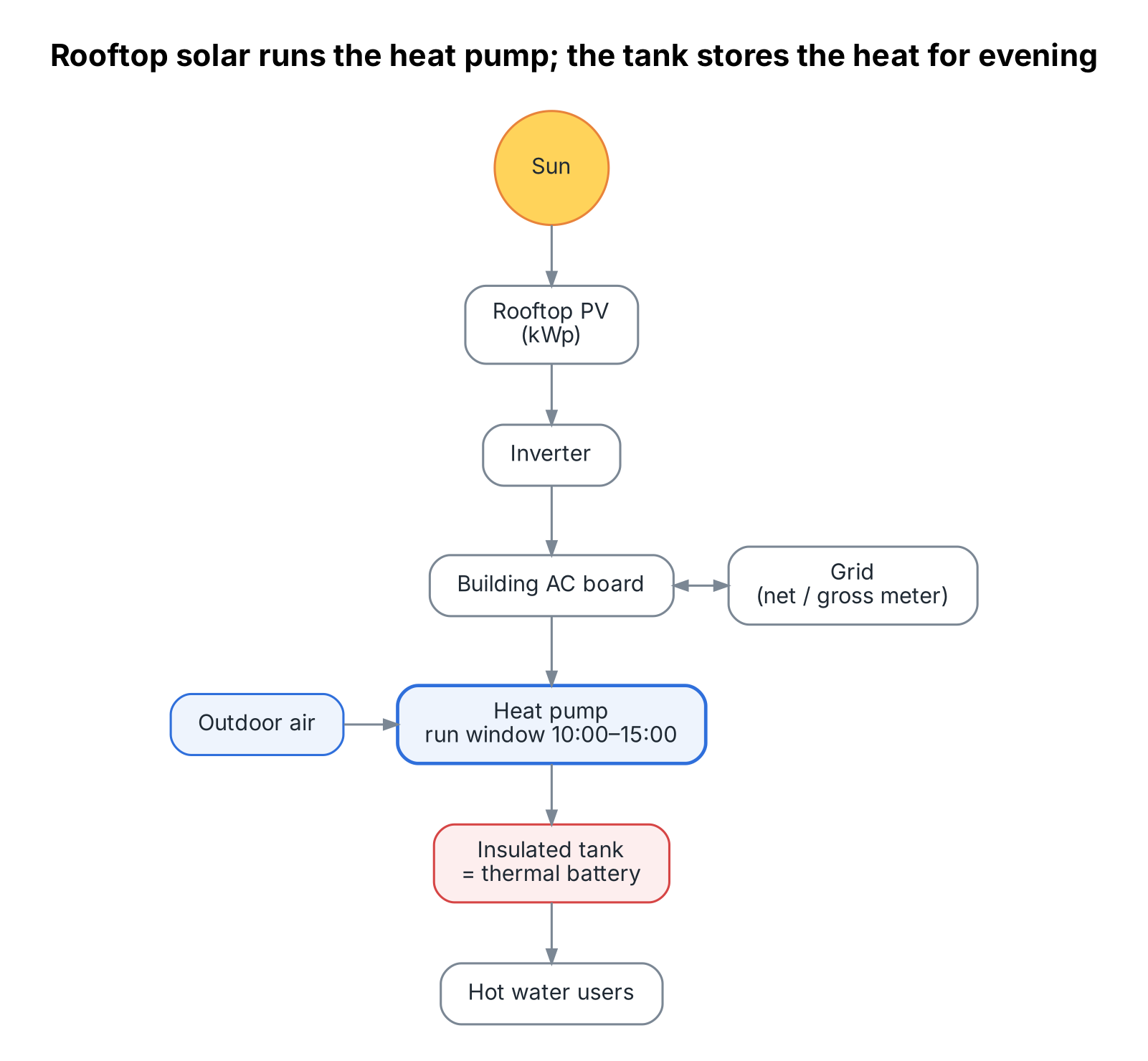
PV makes power at midday. Hot water is often needed in the morning and evening. A well-insulated tank bridges the gap. Heat from a heat pump in the tank is a "thermal battery" that costs far less per kWh stored than a lithium battery.
| Metering type | How it works (general) | Best heat pump strategy |
|---|---|---|
| Net metering | Exported units offset imported units | Daytime running still preferred; check state caps |
| Gross metering | All PV is sold at a fixed tariff | Heat pump simply buys from grid |
| Self-consumption only | No export credit | Run heat pump in solar hours to avoid wasting PV |
Rules on net and gross metering vary by state and DISCOM (distribution company). Check the current regulation before you size the system.
Worked example — sizing PV for the Bengaluru hotel heat pump

- Daily heat pump use ≈ 35 kWh.
- Typical yield in Bengaluru ≈ 4.5 kWh/kWp/day.
- PV size = 35 ÷ 4.5 ≈ 7.8 → choose 8 kWp.
- Roof area at a typical 8–10 m²/kWp: about 65–80 m² of shade-free roof.
- Yearly PV energy ≈ 8 × 4.5 × 365 ≈ 13,140 kWh. At ₹9/kWh that is ≈ ₹1.18 lakh/yr avoided.
- Example PV cost ₹50,000/kWp → ₹4.0 lakh. Simple payback ≈ 3.4 years.
Remember
- 1 kWp gives typically 4–5 kWh/day in India.
- Run the heat pump in solar hours and store heat in the tank.
- Thermal storage is cheaper than battery storage.
- Check state metering rules before sizing.
solar PV plus a heat pump plus a hot water tank stores sunshine as hot water, which is cheaper than storing it in batteries.
There are no comments for now.
to be the first to leave a comment.