6.5 Calculating CO₂ savings
An emission factor is the CO₂ released per unit of energy used. For grid electricity it is the CO₂ from power stations per kWh delivered. India's grid factor is approximately 0.7 kg CO₂/kWh because much power comes from coal. It is falling as solar and wind grow.
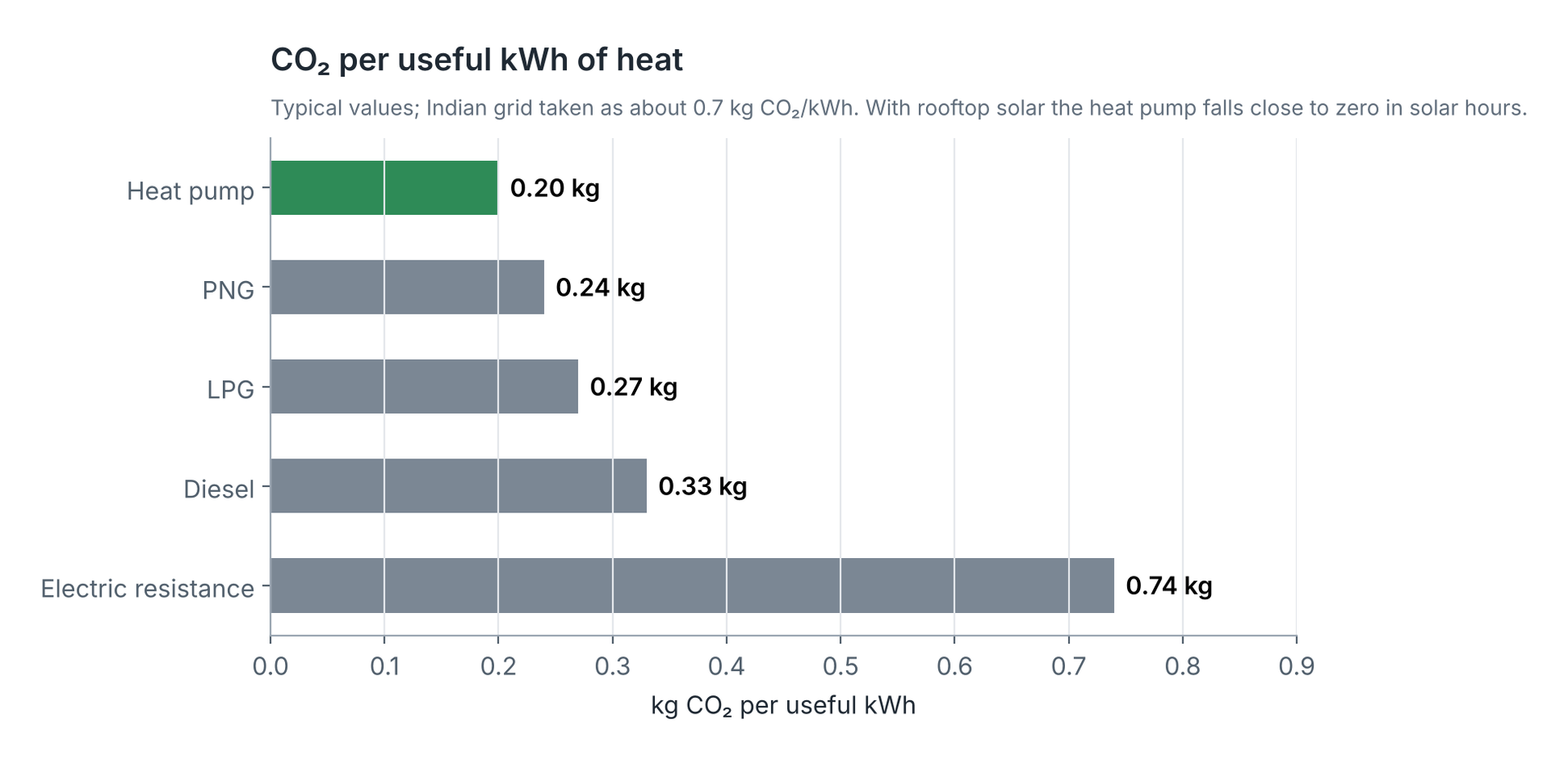
Because a heat pump divides the grid factor by its COP, it emits less CO₂ per useful kWh than LPG or diesel; against PNG it breaks even at about COP 3, so it wins when its seasonal COP is above about 3 or as the grid gets cleaner.
Typical emission factors (approximate)
| Source | Per unit | Per kWh of fuel (NCV) |
|---|---|---|
| Grid electricity (India, approximate) | 0.7 kg/kWh | 0.70 kg |
| LPG | ~2.98 kg/kg | ~0.23 kg |
| PNG / natural gas | ~1.9 kg/scm | ~0.20 kg |
| Diesel | ~2.68 kg/L | ~0.27 kg |
| Biomass (sustainably sourced) | Treated as near-zero net CO₂ | ~0 (biogenic) |
CO₂ per useful kWh (typical)
| Source | Factor ÷ efficiency | kg CO₂ per useful kWh |
|---|---|---|
| Heat pump, COP 3.5 | 0.70 ÷ 3.5 | 0.20 |
| PNG boiler | 0.20 ÷ 0.85 | 0.24 |
| LPG boiler | 0.23 ÷ 0.85 | 0.27 |
| Diesel boiler | 0.27 ÷ 0.80 | 0.33 |
| Electric resistance | 0.70 ÷ 0.95 | 0.74 |
Worked example — hotel in Goa replacing a diesel boiler
Demand: 2,000 L/day from 25 °C to 60 °C.

- Daily heat = 2,000 × 4.186 × 35 ÷ 3,600 = 81.4 kWh. Yearly ≈ 29,720 kWh.
- Diesel: 29,720 ÷ (10.0 × 0.80) ≈ 3,715 L. CO₂ = 3,715 × 2.68 ≈ 9.96 t/yr.
- Heat pump: 29,720 ÷ 3.5 ≈ 8,490 kWh. CO₂ = 8,490 × 0.7 ≈ 5.94 t/yr.
- Saving ≈ 4.0 t CO₂ per year, about 40%.
- Cost bonus: diesel ₹3.72 lakh vs heat pump ₹0.76 lakh per year (example rates).
Remember
- Use an approximate grid factor of 0.7 kg/kWh and state it.
- Divide the factor by COP or efficiency.
- Heat pumps beat electric geysers by about 3–4 times on CO₂.
- Savings grow as the grid gets cleaner.
CO₂ per useful kWh = emission factor of the energy source ÷ efficiency or COP.
There are no comments for now.
to be the first to leave a comment.