6.3 Payback, ROI and lifecycle cost
Simple payback is the number of years the yearly saving takes to repay the extra investment. ROI (return on investment) is the yearly saving as a percentage of investment. Lifecycle cost adds up purchase, energy, maintenance and replacement over the equipment's life.
It is like choosing between a cheap two-wheeler that drinks petrol and a costlier efficient one. After a few years the efficient one has paid for its extra price.
Lifecycle cost often uses NPV (net present value). NPV discounts future savings because ₹1 next year is worth less than ₹1 today. The discount rate is usually the company's cost of capital.
Worked example — hotel in Bengaluru replacing LPG for hot water
Demand: 3,000 litres per day heated from 25 °C to 60 °C, every day.

- Daily heat: Q = 3,000 kg × 4.186 kJ/kg·K × 35 K = 439,530 kJ ÷ 3,600 = 122 kWh/day.
- Yearly heat: 122 × 365 ≈ 44,560 kWh.
- LPG: 44,560 ÷ (12.8 × 0.85) ≈ 4,096 kg × ₹100 = ₹4.10 lakh. Add maintenance ₹10,000 (example). Total ≈ ₹4.20 lakh/yr.
- Heat pump at COP 3.5: 44,560 ÷ 3.5 ≈ 12,730 kWh × ₹9 = ₹1.15 lakh. Add maintenance ₹15,000 (example). Total ≈ ₹1.30 lakh/yr.
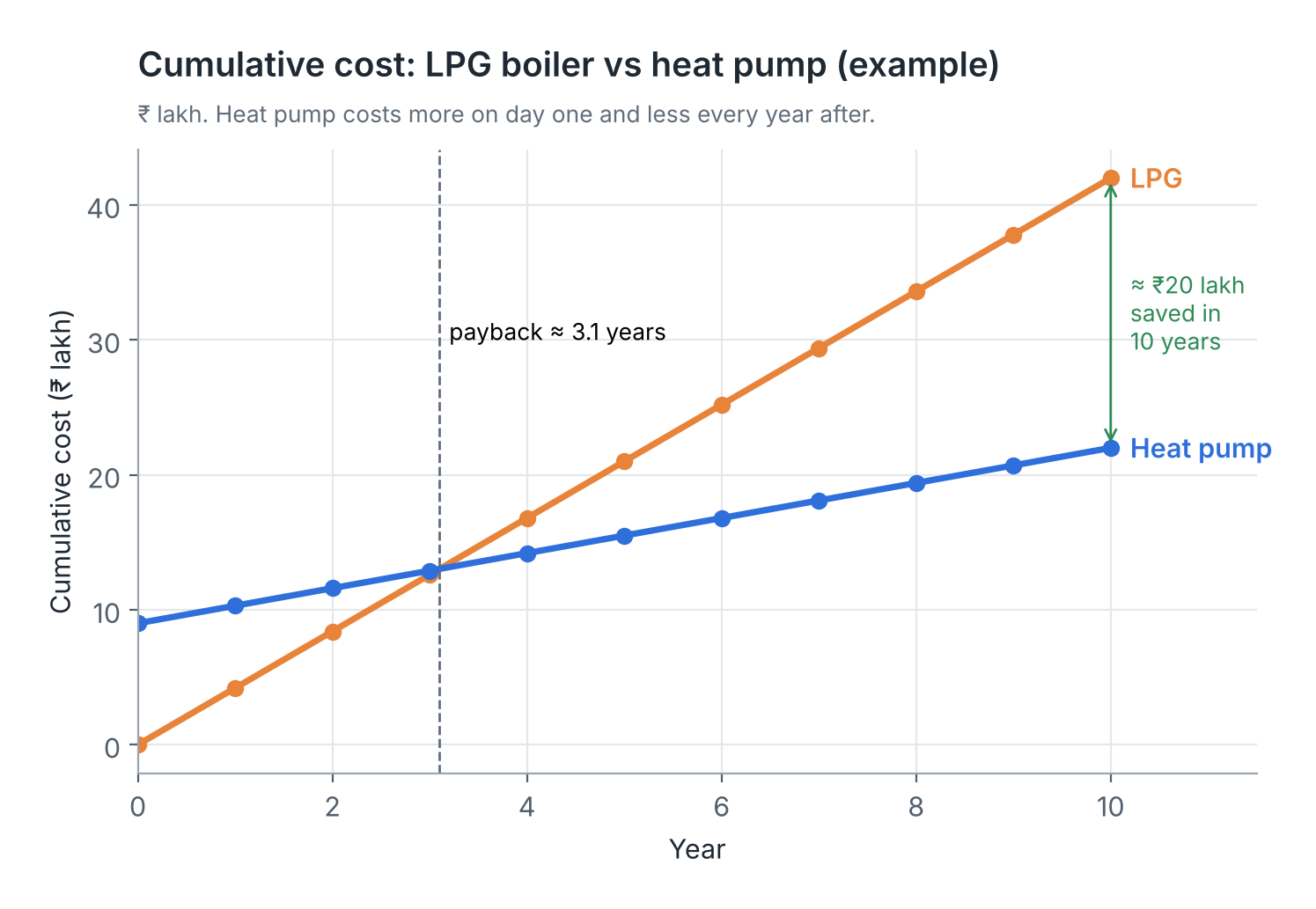
- Net annual saving ≈ ₹4.20 − ₹1.30 = ₹2.90 lakh.
- Installed heat pump system (example): ₹9.0 lakh. Simple payback = 9.0 ÷ 2.90 ≈ 3.1 years.
- Simple ROI = 2.90 ÷ 9.0 ≈ 32% per year.
- NPV over 10 years at 10% discount rate: annuity factor = (1 − 1.1⁻¹⁰) ÷ 0.1 = 6.145. NPV = 2.90 × 6.145 − 9.0 ≈ ₹8.8 lakh.
| Measure | What it tells you | Weakness |
|---|---|---|
| Simple payback | How fast the money comes back | Ignores savings after payback and time value of money |
| Simple ROI | Yearly return on capital | Same as above |
| NPV | Value created today, in ₹ | Needs a discount rate assumption |
| IRR (internal rate of return) | The discount rate at which NPV = 0 | Harder to explain; can mislead on small projects |
| Lifecycle cost | Total cost of ownership | Needs life and replacement assumptions |
Remember
- Payback = extra capital ÷ net annual saving.
- Include maintenance on both sides.
- NPV shows value; payback shows speed.
- Test the result with higher and lower fuel prices (sensitivity).
a heat pump costs more to buy but less to run, so judge it over its whole life, not on purchase price.
There are no comments for now.
to be the first to leave a comment.