6.4 Electricity tariffs and time-of-day operation
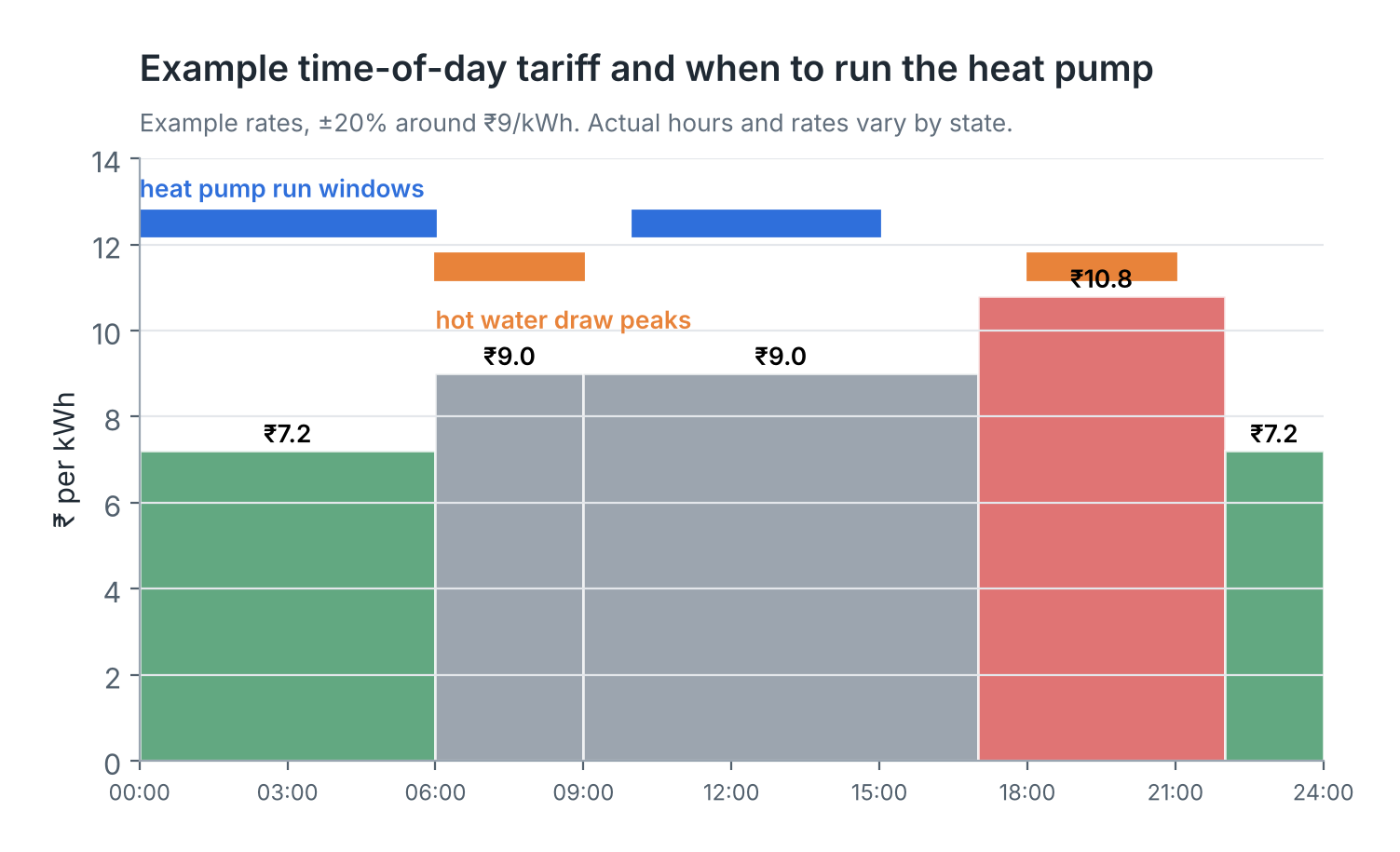
Many Indian commercial and industrial tariffs have time-of-day (ToD) rates. ToD means the energy rate changes by hour. Peak hours cost more; off-peak or solar hours may cost less. The exact hours and percentages differ by state and change often.
A hot water tank works like a battery for heat. You fill it when power is cheap and draw from it when needed. The heat pump heats the tank in cheap hours; the building uses the hot water later.
Bills also contain fixed or demand charges. Demand charge is billed on maximum kVA (kilovolt-ampere) drawn, per month. Starting several large machines together can raise it.
| Choice | Effect on cost | Effect on COP |
|---|---|---|
| Run in daytime (warm air) | Normal or solar-hour rate | Higher COP |
| Run at night off-peak | Lower rate | Lower COP in winter, as air is colder |
| Avoid evening peak | Avoids peak surcharge | Neutral |
| Stagger compressor starts | Lower demand charge | Neutral |
In hot climates such as Chennai, night COP falls only slightly. In Delhi or Dehradun winters, night air can be 5–10 °C colder than afternoon air. That can cancel part of the off-peak saving.
Worked example — shifting the Bengaluru hotel load

- Daily heat pump electricity: 12,730 ÷ 365 ≈ 35 kWh.
- Example rates: peak ₹10.8 (+20%), off-peak ₹7.2 (−20%).
- All at peak: 35 × 10.8 = ₹378. All off-peak: 35 × 7.2 = ₹252.
- Daily saving = ₹126. Yearly ≈ ₹46,000, before any COP change.
Remember
- Storage tanks let heat pumps follow cheap tariff hours.
- Check the current state tariff order for ToD hours.
- Balance cheaper night rates against lower night COP.
- Watch demand charges, not only energy charges.
with a hot water tank, a heat pump can run when electricity is cheapest, cutting running cost further.
There are no comments for now.
to be the first to leave a comment.