Replacing a Diesel-Fired Boiler with an Industrial Heat Pump: A Reckitt Benckiser Case Study
Meta description: How Reckitt Benckiser (India) replaced a diesel-fired hot water boiler with a Sunniva industrial heat pump array — cutting process heating costs by over 55% while eliminating fossil-fuel emissions from Dettol Liquid Soap manufacturing.
Why Thermal Precision Matters in Pharma and FMCG Manufacturing
In high-standard pharmaceutical and chemical consumer goods production, thermal precision isn't a convenience — it's a compliance and quality requirement. Product stability, chemical reactivity, and facility safety all depend on absolute, repeatable temperature baselines, not heating systems that overshoot, drift, or fluctuate with load. This is exactly why industrial Air-to-Water Heat Pumps (AWHPs) are increasingly replacing boilers and electric heaters as the thermal driver of choice across processing lines that demand tight, consistent control.
Advanced Humidity Control & Clean Room Regulation
Pharmaceutical and precision chemical packaging environments operate under strict atmospheric moisture standards. Meeting them typically requires a two-stage process:
- Deep moisture extraction — Air Handling Units (AHUs) chill incoming air below its dew point to condense out ambient moisture, leaving the air dry but too cold for clean room use.
- Thermodynamic reheating — that overly cold, dry air must then be reheated to precise ambient standards before it enters sterile manufacturing spaces. Stable hot water loops are essential here: any temperature fluctuation risks destabilizing the room environment and can cause hygroscopic powder formulations to clump.
Heat pumps excel in this reheating stage because they deliver consistent, tightly controlled hot water without the temperature swings associated with cycling boilers.
Reactor Thermal Management & Pre-Heating
Thermal precision is just as critical inside the process itself:
- Endothermic reaction maintenance — fine chemical synthesis relies on steady, non-fluctuating heat input to jacketed glass or stainless-steel reactors. Uneven heating creates localized hot spots that can degrade the product.
- Distillation pre-heating — bringing liquid feed to the correct temperature before it enters a fractionating column reduces thermal shock and improves the energy balance of the entire distillation process.
In both cases, a stable hot water supply — not a hot spike — is what protects product quality.
Case Study: Reckitt Benckiser
Reckitt is a global leader in consumer health, hygiene, and nutrition, with rigorous internal targets for carbon reduction and energy efficiency across its manufacturing footprint. At one facility, this meant re-examining a critical utility: the hot water system feeding Dettol Liquid Soap production.
The Problem
- The plant relied on a diesel-fired boiler to heat DM (demineralised) water to 75°C, indirectly, via a plate heat exchanger (PHE), for use in Dettol Liquid Soap manufacturing.
- Running the boiler was expensive and energy-inefficient.
- It generated substantial GHG emissions, working against Reckitt's sustainability targets.
- The site's winter ambient temperature can drop as low as 5°C, adding load and complexity to any heating solution considered as a replacement.
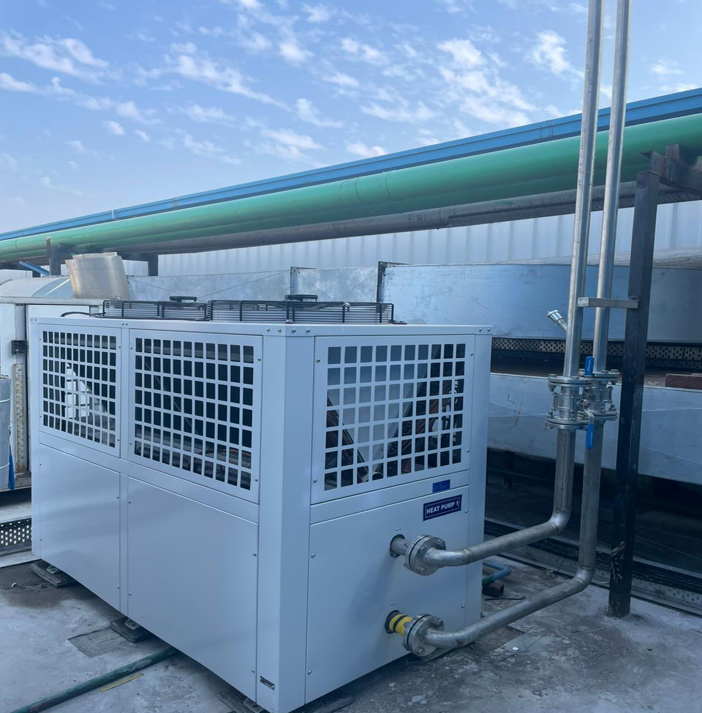
The Solution: A Sunniva Air Source Heat Pump Array
Sunniva proposed an industrial air source heat pump system engineered specifically around Reckitt's hygiene and process constraints:
| Requirement | Solution |
|---|---|
| Hot water demand | 44 KL/day at 80°C |
| Heat pump configuration | 3 x 70 kW units |
| Hygiene compliance | DM water heated indirectly — heat pump raises soft water temperature, which then transfers heat to DM water via a PHE, keeping the DM water loop untouched by the heating circuit |
| Low winter ambient (down to 5°C) | Crankcase heaters fitted to maintain compressor reliability and performance in cold conditions |
Because DM water is used for hygienic purposes, direct heating wasn't an option — the heat pump heats an intermediate soft water loop instead, which then heats the DM water through the PHE. This preserves water purity while still delivering the required 75–80°C output.
The Results
The numbers speak for themselves. Based on a requirement of 44,000 litres/day, heated from 22°C to 72°C:
| Metric | Diesel Boiler | Sunniva Heat Pump |
|---|---|---|
| Efficiency | 90% | 280% (COP 2.8) |
| Operating cost per 100 litres | ₹49.1 | ₹20.8 |
| Total cost per day | ₹21,624 | ₹9,136 |
| Total cost per month | ₹6,48,718 | ₹2,74,086 |
| Total cost per year | ₹77,84,615 | ₹32,89,037 |
Annual savings: ₹44,95,579 — a reduction of roughly 58% in process hot water heating costs.
Beyond the direct cost savings, the switch:
- Eliminated diesel handling and storage on-site, along with the logistics and supply-chain volatility that come with it
- Removed a significant source of GHG emissions, supporting Reckitt's carbon reduction goals
- Removed boiler licensing and flue infrastructure, simplifying compliance and maintenance
- Delivered consistent output temperature, improving process repeatability across the DM water heating loop
The Broader Takeaway for Process Heating
This case illustrates a pattern that holds across pharmaceutical, FMCG, and fine chemical manufacturing: wherever a facility needs stable, repeatable hot water rather than an occasional heat spike, an air source heat pump will typically outperform a diesel boiler or electric heater on both cost and consistency — while also addressing sustainability commitments that fuel-fired systems can't.
If your facility is running a diesel or electric heating system for process hot water — for reactor jackets, clean room reheat, DM/soft water loops, or any similar application — the same engineering approach used at Reckitt can likely be adapted to your site.
Get in touch with Sunniva Encon LLP to find out what a heat pump would cost to run in place of your current boiler or electric heater.
📍 Goregaon West, Mumbai 🌐 www.sunnivaencon.com
#heatpump #industrialheatpump #processheating #pharmamanufacturing #FMCG #dieselboilerreplacement #energyefficiency #manufacturingindia #sunniva #madeinindia