What is Waste Neutrality:
Waste Neutrality is a comprehensive sustainability approach that enables businesses to take immediate responsibility for their environmental impact. Through transparent, verified recovery programs, companies can balance their specific waste material footprint by ensuring equivalent amounts of post-consumer specific stream of waste is collected and processed from the environment, creating measurable positive impact while building circular economy infrastructure.
Mechanism in Plastic deprinting:
Caustic soda {NaOH}, or sodium hydroxide, is primarily used in the industrial recycling of printed plastics to facilitate the removal of inks, labels, and adhesives. Caustic soda's role is largely due to its properties as a strong alkali and is often used in combination with heat and surfactants (detergents) in a washing bath:
Ink/Binder Breakdown (Saponification/Hydrolysis):
Many printing inks, especially those used on plastic films and bottles, contain organic binders (e.g., acrylic or nitrocellulose resins) to adhere the pigments to the plastic.
Caustic soda can chemically attack (hydrolyze or saponify) these organic compounds, breaking down the molecular structure of the ink binder. This significantly weakens the bond between the ink and the plastic surface.
Adhesive and Label Removal:
Caustic soda effectively dissolves or loosens common adhesives and labels (often paper-based or bound with resins), allowing them to detach easily from the plastic. This is often its main function in the initial washing stages of plastic bottle recycling ( like PET).
This high alkalinity can have a synergistic effect with added surfactants (cleaning agents). When the plastic is put in the rotary drum and caustic soda is added along with the other agent it creates a friction between the plastic. The combination helps the surfactants access, dissolve, and lift the ink from the plastic surface, keeping the ink particles suspended in the wash water so they don't re-deposit.
For some types of inks, the alkaline environment can also help to provide a negative surface charge, which promotes the adsorption of cationic surfactants, further aiding in ink detachment.
COMPANY OVERVIEW:
An India-based company, manufactures advanced recycling systems that convert plastic waste into reusable granules.
Company uses the process of de-printing technology which removes the ink from the plastic and makes it in virgin plastic.
Waste is consolidated and pre-sorted by polymer type and broad category. Heavier contaminants are removed early with magnets and coarse screening so downstream equipment is not damaged.
Large items are reduced to flakes or chips in industrial granulators/shredders.
For contaminated film and bottles, wet washing removes dirt, labels, adhesives, and inks.
The cleaned feed is fed to an extrusion/pelletizing section. Melt filters/screens remove small contaminants; degassing/extrusion controls stabilize the melt.
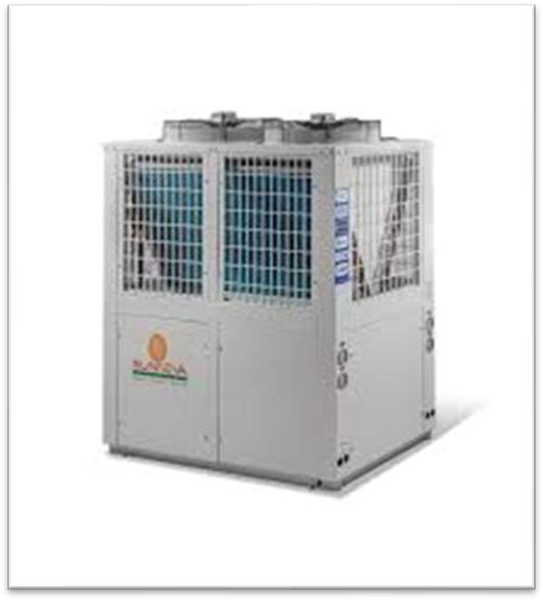
Where Sunniva heat pump comes into use?
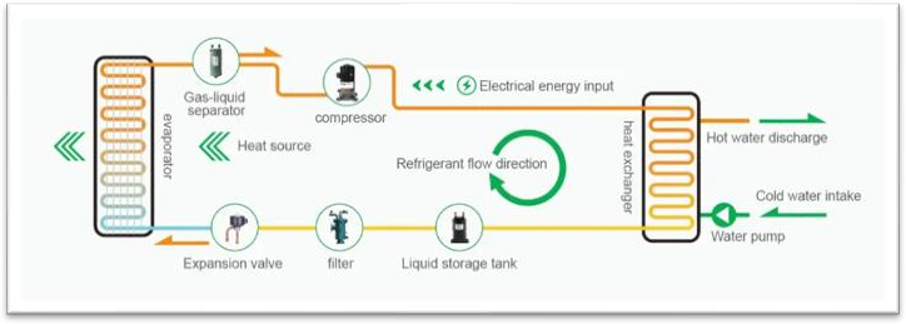
Heat pump helps to heat the water which is been used in the process of ink removal from plastics. Heat pump helps to heat the water faster than any traditional methods of 55-60℃.
By using heat-Pump there has been a 50%-time reduction in the overall process.
Time required for a cycle to perform using traditional method has been reduced to almost half of it, and we can perform double cycle due to heat pump.
HEAT PUMP CYCLE: